
Homeward
scattered notes from Zaporizhzhia

I arrive at the Dnipro railway station to meet K.
Large men in military-style clothes (colour: dirty olive), with toys hanging from their military-style rucksacks: an elephant, a hello kitty, a capybara. Those little people who have given the men those tokens of hope, where are they now? In Warsaw, unlearning their mother tongue? In Kharkiv, under bombardment?
On the way from the city of Dnipro to Zaporizhzhia, clouds and stormy weather dissolve. It’s the south, it’s mid-June, the days are long, and the crops mature steadily under this unapologetic sun. We spot the islands of tender poppies in the fields. Along the highway, there are friendly bus stops decorated with mosaics: flowers, summer fields, and even Zaporizhzhian Cossacks (once). We are driving homeward.
Warding my home is a military checkpoint protected with anti-drone netting. For a skilful drone pilot, diving into this net tunnel is no big deal. Our car is waved in by the servicemen — tenderness, tiredness, strength.
The billboards in Zaporizhzhia feature military recruitment campaigns and advertisements of the coming-soon event with the matriarch of Ukrainian literature. We drink coffee next to the philharmonic. My former home is to the right. I don’t go to look into my former windows this time, not up for a heartbreak. Instead, I take K. for a walk in the socialist city, the 1930s constructivist neighbourhood where time has thickened and refused to move forward. It would provide a suitable setting for Kira Muratova’s film, with half-mad characters emerging in cracked windows, cats hiding behind the columns of a terraced C-shaped building. Parked pickup trucks with roof-mounted electronic warfare are the only new addition.
We take a taxi to the right bank of the Dnipro. We walk to Khortytsia, first glimpsing the island from the arch bridge. On 6 June 2023, Russians blew up the Kakhovka dam downstream, and countless lives were lost to the flood. Water receded from under the Zaporizhzhia hydroelectric power station, or DniproHES, exposing the legendary Dnipro rapids.
I grew up by the Dnipro which had already been transformed by the Soviet industrialisation. The Dnipro of my childhood is the river shackled by the cascade of the hydroelectric power stations, the river made to overflow and flood its historic banks. The river whose might was exploited to power the Soviet project. Magnificent, mine. I loved it.
For the first time, I encounter the river more reminiscent of what it once had been, before the dams. It appears shallow now. The new banks are overgrown with willows. Flocks of birds nest on the rocks.
We sit on the rocks too, me in red, K in white, our pale, defenceless faces absorbing the sun. It burns. The hum of drones and explosions is a constant, as is the melody of steppe wind and the buzzing of insects in high grass.
We absorb the alien landscape. One thing about it is unchanged: it spells freedom, as it always used to.
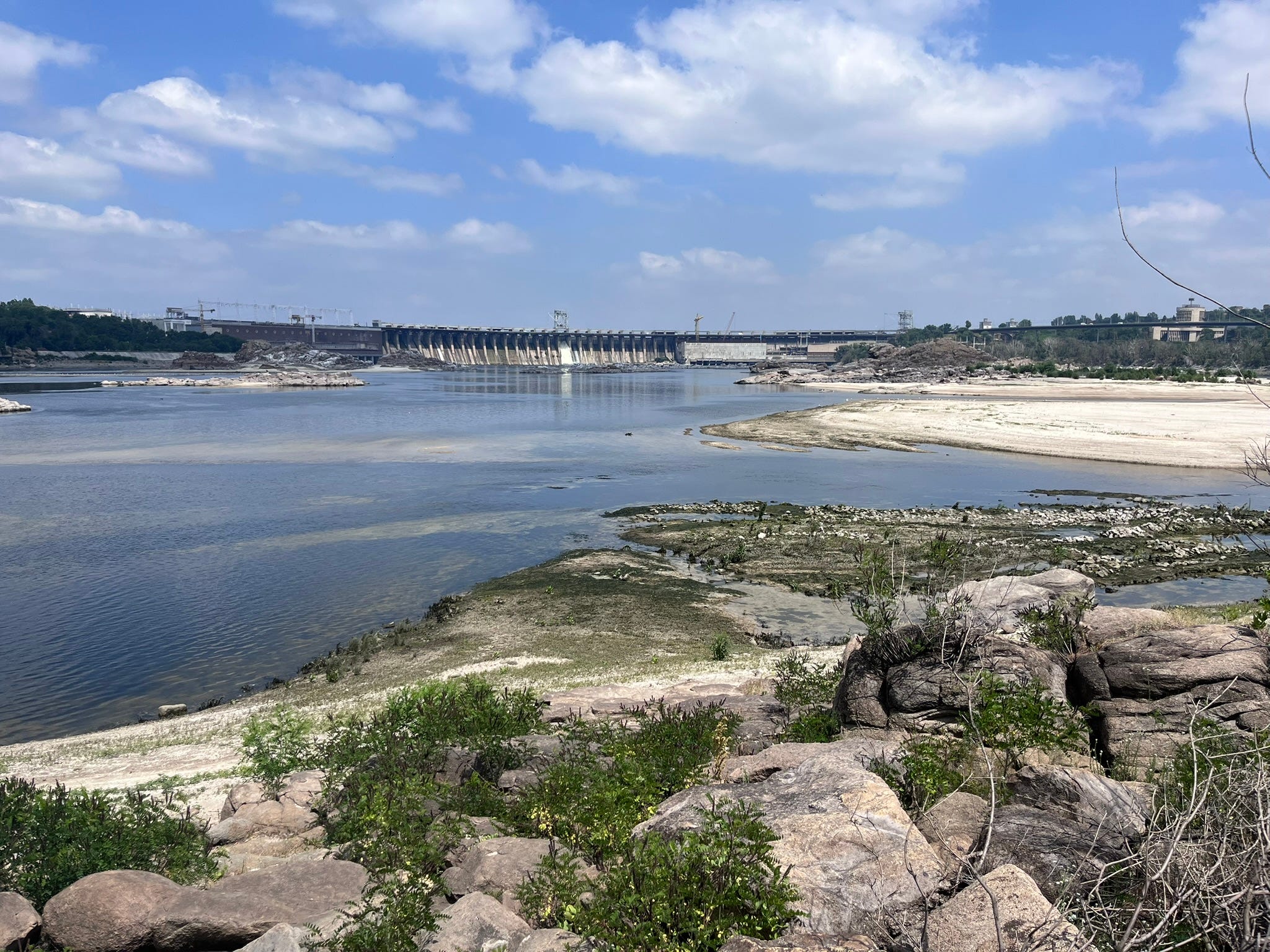
PS: My snapshots can’t convey the brutality of the Soviet relationship with nature imprinted on the DniproHES; the power of Khortytsia over those of us who’ve grown up climbing Scythian sculptures across the island; the loss of the landscape that was the one home we knew, and the humility in the face of its ongoing transformations; the grief, always grief in its evolving forms, turning into love and duty and vengeance and into grief again — our perpetual engine and a new home we found at the end of the world.
PPS: I write a lot about Zaporizhzhia and people who have defended it in Apocalypse Baroque: Tales from Ukraine at War. Hopefully, in a more structured manner.
i love this writing of yours! dazzling from the energy of your zaporizhzhia. thank you.